• Skip to primary navigation
  • Skip to main content
  • Skip to primary sidebar
  • Skip to footer

SacHorse.com

Happenings of the Sacramento Horse Community

  • Home
  • Event Calendar

Articles

Photo Essay on the Homeless Horsemen of Cal-Expo + Article

September 26, 2012 by Mark Thompson Leave a Comment

The Sacramento Bee has a nice photo essay about grooms and horsemen who work at Cal-Expo and their plight with housing.  Many of them have been staying in hallways and converted tack rooms but a recent inspection by the Fire Marshall has judged the facilities to be unsafe for human habitation.  Now the men are camping out in the parking lot or wherever they can find lodging.  To exacerbate issues, they’ve gone for months with no income because Cal-Expo is changing harness racing operators.

To view the photo gallery, please visit: http://www.sacbee.com/2012/09/25/4854701/cal-expos-homeless-horse-people.html?mi_rss=Sports%20Galleries

UPDATE: Here is the complete article: http://www.sacbee.com/2012/09/26/4855271/cal-expo-racetrack-workers-scramble.html

Filed Under: Articles Tagged With: Cal Expo, Harness Racing, Homeless

National Day of the Cowboy & Cowgirl Tomorrow at State Fair

July 28, 2012 by Mark Thompson Leave a Comment

The State Fair will be hosting the first annual National Day of the Cowboy and Cowgirl tomorrow.  Each night there has been a horse demonstration at the horse arena called Cavalcade of Horses which included presentations by the Dianne Olds Rossi, the Sacramento Sheriff’s Equestrian Drill Team, and various other equine presentations.

The National Day of the Cowboy and Cowgirl will bring us an even more in depth equestrian presentation.  Curt Pate, national horsemanship and stockmanship clinician, will be doing horse training demonstrations.  There will also be stock dog demonstrations, the California Cowgirls Drill Team, demonstrations by reiners, barrel racers and other modern-day cowboys and cowgirls. Also cowboy and cowgirl activities for kids.

The press release from the State Fair is included below:

SACRAMENTO, Calif. (July 27) —  The California State Fair is
celebrating the National Day of the Cowboy and Cowgirl in rough-riding
style this Saturday, July 28 at 7pm. The Cavalcade of Horses is hosting
a two-hour show featuring cowboys and cowgirls riding, roping and
wrangling.

Cowboys and cowgirls will demonstrate equestrian drills, a cattle
drive, horse reining, barrel races, the skills of cow dogs, a trail
horse competition, and a wagon train like those in pioneer days.

The National Day of the Cowboy and Cowgirl is the result of a recent
California resolution designating the fourth Saturday in July as
“National Day of the Cowboy and Cowgirl.” California is the second
state to pass such a resolution and the first to specify “Cowgirl” as
well as “Cowboy”.

The celebration is free to attend with Fair admission.

Filed Under: Articles

Draft Horse Classic Coming In September

July 19, 2012 by Mark Thompson Leave a Comment

Once again the Nevada County Fairgrounds in Grass Valley will play host to the Draft Horse Classic Poster26th annual Draft Horse Classic and Harvest Fair from September 20th through the 23rd.  The show gives you your money’s worth with a range of competitions from pulling carriages, working farm equipment, and driving teams of horses all the while showcasing Clydesdales, Percherons, Shires, and a number of other draft breeds.
In addition to the time in the arena, there is the opportunity to get up close and personal with the horses.  During times prior to the show, spectators can visit the barns and watch as staff from the stables prepare their steeds for the performance.  For a more formal introduction, there is the opportunity to receive a guided tour of the barns on Friday and Saturday.  Reservations are required.

The Draft Horse Classic also hosts a Harvest Fair with many booths selling all sorts of wares, food vendors, and musical performances.  New this year will be a Sausage and Brew Fest on Saturday and the 2nd Annual Classic Rib Cook-Off will be from 1:30 to 4:00 pm on Sunday.  I recommend getting there early, last year most of the vendors were sold out of ribs an hour or so after the competition began.

There will be five performances for this years classic.  The dates and times are listed below:

Thursday, September 20 6:30 pm
Friday, September 21 6:30 pm
Saturday, September 22 10:00 am
Saturday, September 22 6:30 pm
Sunday, September 23 10:00 am
Sunday, September 23 4:00 pm

Tickets for the evening and afternoon shows are $21 for reserved seating and $18 for general admission.  For morning performances, tickets are $15 for reserved and $12 for GA.  Children (ages 12 and under), are $13 reserved for $10 GA for any performance.  To purchase tickets, please visit www.nevadacountyfair.com/dhc.

Nevada County Fairgrounds is located on McCourtney Road in Grass Valley, just 50 miles northeast of Sacramento.

For more information, please visit: www.nevadacountyfair.com/dhc or call (530) 273-6217.

Find a performance schedule at: www.nevadacountyfair.com/dhc/schedule.html

Filed Under: Articles, Event News, News

California State Fair Horse Shows Begin Tomorrow, July 13th

July 12, 2012 by Mark Thompson Leave a Comment

The California State Fair will host two horse show this year.  There will be a Ranch Horse Versatility Competition on July 13th from 6 am to 7 pm in the Rodeo Arena.  Also in the Rodeo Arena, 4H will hold their state horse competition on both Sunday, July 15th and Monday, July 16th.  Both competitions will be going most of the day.

In addition to the horse shows, the State Fair will once again be featuring 8 days of live Thoroughbred, Arabian, Quarter Horse, and Mule racing at Cal Expo’s Miller Lite Grandstand July 12-15 and 19-22. The first race is at 1:45 PM on Thursdays, Saturdays and Sundays and 3:45 PM on Fridays.

A cool feature for Fair attendees will be the ability to take a tour of the race track.  Each racing day, attendees can gather at the winner’s circle and they’ll be escorted on to the track and receive a presentation on track maintenance and participate in a question and answer session.  Tours begin each racing day at 1:00 pm except Fridays which begins at 3:00 pm.

The Fair will also be hosting the Cavalcade of Horses.  This event provides a ton of great activities for the entire family.  At the Cavalcade will be a Kid’s Horse Play Area; presentations including My First Ride and Horse Behavior Revealed, and daily horse demonstrations.  The daily schedule is below:

5 pm – Fun on Horseback

7 pm – Carousel of Breeds

8 pm – Nu Balance Vaulters

8 pm – Dianne Olds Rossi’s Magical World of Dancing Horses

8 pm – California Cowgirls

On July 28th, come out and celebrate the National Day of the Cowboy and Cowgirl.  At 7 pm, the Fair will host a wide array of demonstrations including clinician Curt Pate will provide horse demonstrations, stock dog demonstrations, California Cowgirls Drill Team, demonstrations by reiners, barrel racers and other modern-day cowboys and cowgirls.

SacHorse will be out at the State Fair covering all these events.  Be looking for additional articles and all of our pictures.  If you see us at the fair, please say hello and let us know you’re a SacHorse reader!

For more information, please visit the State Fair’s website at bigfun.org.

Filed Under: Articles

Ready for Horse Expo?

June 4, 2012 by Mark Thompson Leave a Comment

The biggest horse event for the Sacramento area starts this week! There is something for every horse person to enjoy. The Western States Horse Expo is the place for shopping, clinics, demonstrations, and more! Here are some highlights to check out:

Thursday is the Magnificent 7 preliminary competition. 15 horse and rider teams compete in rein work, herd work, steer stopping, and fence work for a spot in the finals on Friday night. Thursday is free to watch, so go and cheer on your favorite team. The list of goes and more information are here The Friday night finals require a different ticket to get in and can be purchased at the expo. The tickets are $15 and the show starts at 7pm. This years judges include Benny Guitron and Bob Avila.

The expo officially opens on Friday at 9am. Friday and Saturday are open from 9am to 7pm. Sunday is 9am until 5pm. Tickets are$18. A three day pass is $45. Kids 7-13 are $5 (6 and under are free) Sunday is Senior day and tickets are $12 for 60 and older. $3 off coupon can be found here Half off tickets are available here

New this year is Project Cowgirl. It will test riders skills with their horse and in front of a camera for a chance at their own show on RFD-TV. Rounds 1 & 2 of the competition are free to watch and happen on the morning of Friday, June 8th, at 9am. The other eliminations are on Saturday at 9am. Finals are on Sunday at 10am. More information here

Young Rider Park is a great place to take the horse crazy kids in your life. Kids can paint a real horse, go on a pony ride, and there is a petting zoo. The Young Rider Park is open all day everyday. More info here

If you have never watched horse driving then the Expo is the place to check it out. The Driving Darby is an competition where horse(s) and driver(s) complete an obstacle course with speed and precision. It is always great fun to watch. It runs on Friday from 4-6pm and on Sunday from 9-11am in the Ram Truck Freedom Arena. Check it out here

Make sure to swing by the horse sale to see a nice selection of 90 riding horses, broodmares, and yearlings consigned to sell on Saturday. There is even a Zebra in the sale! Check out more information and a list of consigned equines here

If you are looking to purchase some art or just enjoy it don’t miss the annual art show. The art show is open the whole expo and be sure to vote for your favorites! More info here

Interested in learning something new? Check out this list of presenters for this year’s Expo:

  • Chris Cox
  • Steve Rother
  • Larry Whitesell
  • Eitan Beth-Halachmy
  • Sue Thompson, DVM
  • Christy Landwehr
  • John Shelle Ph.D.
  • Peggy Cummings
  • John Bozanich
  • Tim Kimura
  • Richard Godbee
  • Bernie Traurig
  • Lynn Palm
  • Jim Materson
  • Clair Thunes, Ph.D.
  • Robert M. Miller DVM
  • Bree Krebel
  • Shannon Dueck
  • Dana Hokana
  • Don Gustafson

Like to learn about new breeds? The following breeds are having demonstrations:

  • Andalusian
  • Arabian
  • Kiger Mustang
  • Thoroughbred
  • Wild Horse BLM
  • Highland Pony
  • American Miniature
  • Friesian
  • Rocky Mountain
  • American Bashkir Curly
  • Peruvian Paso
  • Tennessee Walker


Filed Under: Articles Tagged With: western states horse expo

Free Horse eBook Available for your Kindle (& Kindle App)

April 25, 2012 by Mark Thompson Leave a Comment

If you haven’t investigated e-readers before, they’re really nifty devices.  Although some people will still love the feel and look of ink on paper, reading books on e-readers can provide convenience, portability, and in some cases cost*.  And you may already have an e-reader and not even know it.  While most people might think that of traditional e-readers such as Amazon’s Kindle and Barnes & Noble’s Nook, almost all smartphones have Kindle and Nook apps to allow you to read on your smart phone as well as on your tablet, like Apple’s Ipad.

* I mentioned cost earlier.  That’s because Amazon often provides free and cheap books to support their Kindle device.  One such book that they currently have for free is “Thoroughbreds and Trailer Trash” by Bev Petterson.  Here’s a description of the book from Amazon:

Jenna Murphy, a dedicated horse masseuse, relies on her job and street smarts to support what’s most important…her younger sister. But when the Thoroughbred Wellness Center experiences a hostile takeover headed by a charming but ruthless corporate shark, both her heart and career are in jeopardy.

Marie B reviewed the book and said:

Thoroughbreds and Trailer Trash takes place at an equine wellness facility that is in the middle of a hostile takeover. Burke, an executive, shows up to “flip” the center; he wants to cater to wealthy clients, and hopes to impress them with very qualified staff. Jenna, a talented horse masseuse, gets results, but is self-taught; she didn’t even graduate from high school. She can’t afford to lose the job; she’s putting her little sister through college by herself, so as she gets closer to Burke, she’s torn between coming clean and looking after what’s most important to her, her sister.

I absolutely LOVED Jenna. The girl’s completely hilarious! She gets herself into some trouble, but everything that she does is to protect her family, friends, and of course, her elderly pony, Peanut. Burke, the poor guy, doesn’t know what to make of her most of the time, but he he really is sweet, under all of the scary businessman stuff. It was cute how Jenna was the only person who wasn’t intimidated by him!

If you like Horses and Romance, then this book may be just the ticket.  Bev Petterson generally focuses on horses and she has produced the Racetrack Romance Box Set including: “Jockeys and Jewels,” “Color My Horse,” and “Fillies and Females,” none of which are over $3.19 on the Kindle.

If you’re interested, be sure to hurry…often times books are only free for a day or two.  But even if the price goes up, you’ll still be able to pick it up at the “Digital List Price” of $3.99.

And if you’ve read it, please be sure to share your opinions here!

Click the link below to download the book from Amazon.

Filed Under: Articles Tagged With: amazon, ereader, horse book, kindle

Similar But Different Andalusian / Azteca / Lusitano

February 23, 2012 by Mark Thompson Leave a Comment

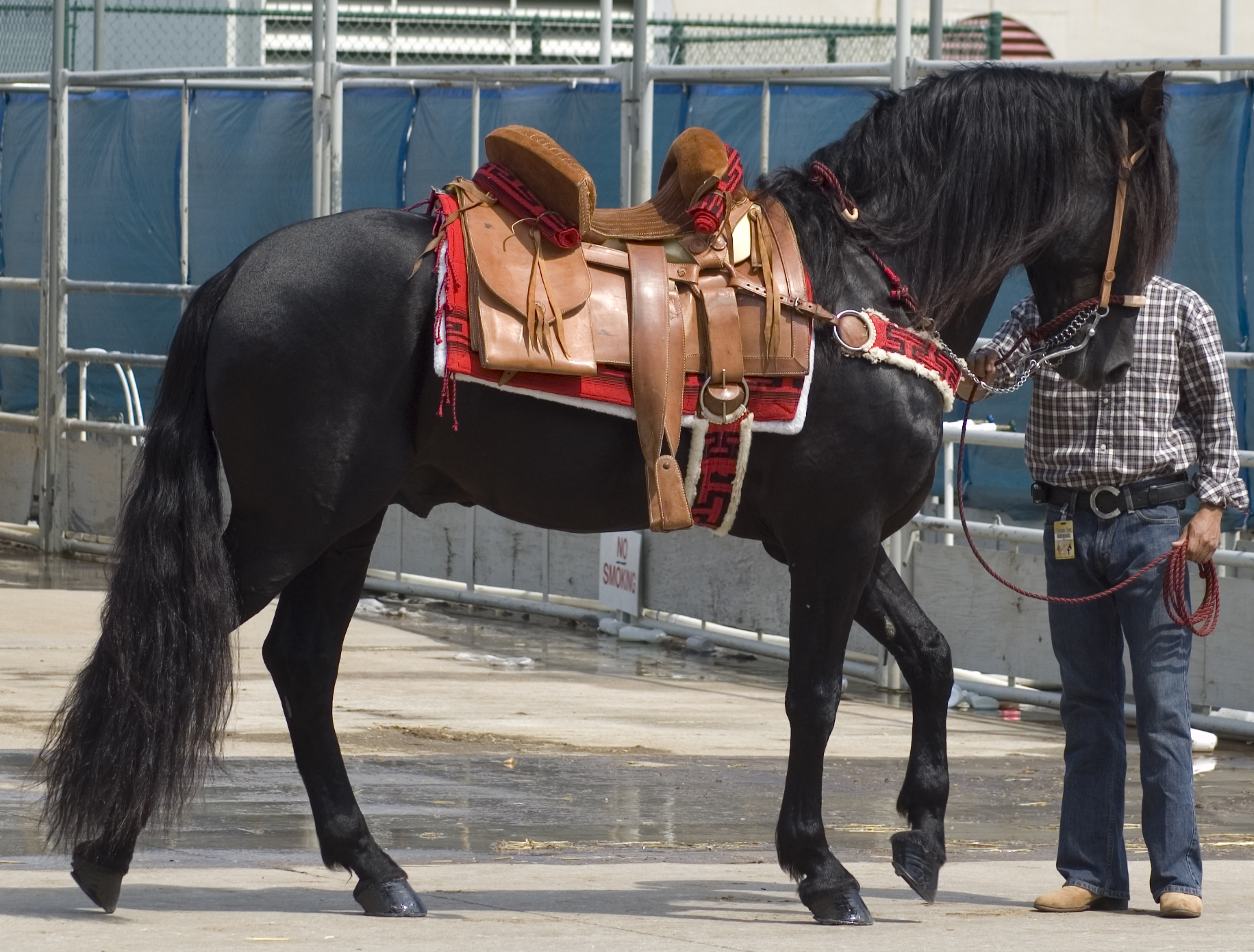
The above horses are in order from left to right: a Lusitano, an Azteca and an Andalusian. Each shown in their native country tack.

Azteca

Don Antonio imported Spanish Andalusian horses and began to breed them at Rancho San Antonio near Texcoco in the state of Mexico. Selection for the Azteca breed began by the crossing of these Spanish Andalusian stallions with Quarter Horse mares or alternatively the crossing of Andalusians with mares of mixed Criollo blood. The Azteca may have a minimum of 3/8 to a maximum of 5/8 Andalusian or Quarter Horse blood, while the percentage of Criollo may not exceed 1/4. The breed aims at blending the qualities of the Andalusian and Quarter Horse. The result is an elegant animal, ideal for performance or pleasure riding.

One of the most important characteristics related to conformation of the Azteca is the height of the horse. At an adult age the height of the Azteca should be 14.1 to 15.2 hands in the female and 14.2 to 15.3 hands in the males. This height was established in consideration of the Azteca’s intended use in Charreria.

The coat is silky and all colors are permissible but paints, appaloosa and albino are not accepted in the breed.

(SacHorse in: There are no albino horses. Albinos are characterized by red eyes, and is not possible in horses)

More here from State of Oklahoma Horse Breeds

Andalusian

The Andalusian horse has been highly regarded since the Middle Ages. Also the Andalusian, has officially been known as the Purebred Spanish Horse, reigned for several centuries throughout the known world as the embodiment of perfection in horseflesh. The Andalusian is represented by the names Iberian Saddle Horse, Iberian War Horse, Jennet, Ginete, Lusitano, Alter Real, Carthusian, Spanish Horse, Portuguese, Peninsular, Castilian, Extremeno, Villanos, Zapata, and Zamaranos.

The Andalusian has a distinguished appearance, usually appearing in the colors white and light gray, and occasionally bay. It is a compact horse with excellent proportions, and usually stands at 15.2 hands. The mane and tail are abundant. It has a flat or slightly convex nose, small ears, and its head is set on a substantial neck. The chest is quite massive and the quarters are lean. The legs are clean and the action is quite energetic. The Andalusian is renowned for its ability to learn and its superb temperament.

More here from State of Oklahoma Horse Breeds

Lusitano

The Lusitano is found in Portugal.  These horses are very similar in conformation to the Andalusian horses of Spain.  The two breed are thought to have originated from a common source but selection in the Lusitano has resulted in a more convex profile reminiscent of the old Andalusian or Iberian horse whereas the Andalusian as developed a more Oriental head shape.

Since setting up their own Stud Book, the Portuguese have been able to make great strides in monitoring and improving the breeding program. Having been sought after over the centuries as a war horse, the same genetic abilities enable the Lusitano to be the perfect horse for mounted bullfighting in Portugal. In Portugal the bulls are not killed in the bullring so the horse must be very agile and still remain calm.

Lusitano horses are generally between 15.1 – 15.3 h.h but there are some that make over 16 h.h. Often gray or bay, they may be any true color, including dun and chestnut.

More here from State of Oklahoma Horse Breeds

Filed Under: Articles, Similar but Different Tagged With: andalusian, azteca, criollo, iberian, lusitano, quarter horse, similar but different, spanish

EPA: Fertility Control Vaccine Approved for U.S. Wild Horses

February 19, 2012 by Mark Thompson Leave a Comment

The Environmental Protection Agency (EPA) has officially registered the first contraceptive vaccine for horses after more than two decades of trial and study. The registration was sponsored by the Humane Society of the United States (HSUS).

“This welcome announcement marks a watershed in the humane management of wild animals,” said Wayne Pacelle, president and CEO of The HSUS. “This is a win-win-win-good for horses, good for wildlands management, and good for taxpayers. Expanding the use of this proven contraceptive should lead to a significant reduction in wild horse gathering, relocation, and … pasturing in long term holding facilities.”

Read More

Filed Under: Articles, Health, National Horse News, News Tagged With: birth control, blm, fertility, herd control, management, mustangs, pzp

Similar but Different Miniature / Falabella / Shetland Pony

January 25, 2012 by Mark Thompson Leave a Comment

Can you tell the difference between a Falabella Miniature Horse, a Miniature Horse, and a Shetland Pony? Check out the pictures and then see how you fared against the answers.

The first picture is a Miniature Horse, the second a Shetland Pony, and the third is the Falabella. While these three breeds could be easily mistaken for one another, the important part is to look at their heritage and bloodlines.

Falabella

From the FMHA

The Falabella Breed has it’s own FMHA Registration Association to certify their pure Falabella ancestry. They have been kept pure by the Falabella Farms in Argentina and by small groups of dedicated Breeders all over the World who want to preserve their precious heritage.

The Falabella is extremely rare. There are less than 900 Falabella’s registered in the FMHA. Only small herds are known to exist in most countries and their number is estimated to be only a few thousand in the entire World. Over the past 10 years, they have been gaining popularity among breeders because of their rarity. This is creating a strong demand and limited supply due to the small number in existence. Most Falabella’s reside at the Falabella Farms in Argentina and in scattered smaller groups throughout the USA, Canada, the UK and other Countries in the World. . They are highly prized and valued by those who own them.

Pure Falabella’s make up a tiny part of the ever growing number of AMHA and AMHR registered American Miniatures. They are sometimes hard to aquire due to their limited numbers and strong appeal. They are favorites among Falabella Fanciers who want just a few “special” Mini’s and Falabella Breeders who are always looking to aquire Herdsire prospects and brood stock.An FMHA Registration Certificate authenticates the pure Falabella ancestry and makes them a very prestigious Miniature Breed. There is much “recorded history” of the famous Falabella in many Miniature Horse books, and they are well known by all professional Breeders as one of the original true Miniatures. Falabella’s are creating strong appeal to breeders who want something special and “different.” A growing number of Miniature Breeders are becoming Falabella Breeders or adding Falabella’s to their own breeding program. If you want a Miniature Horse, you can find them in any State, but If you want a FALABELLA Miniature, you can ONLY get them from a FALABELLA BREEDER. FOR THIS REASON, The FALABELLA is a good investment with a long term outlook to HOLD VALUE due to the current small number of available breeding stock. The supply of Falabella Miniatures is very limited, so demand and marketability will remain very good for many years into the future.

Shetland Pony

From Wikipedia

The Shetland pony is a breed of pony originating in the Shetland Isles. Shetlands range in size from a minimum height of approximately 28 inches to an official maximum height of 42 inches (10.2 hands, 107 cm) at the withers. (11.2 hands for American Shetlands) Shetland ponies have heavy coats, short legs and are considered quite intelligent. They are a very strong breed of pony, used for riding, driving, and pack purposes.

Shetland Ponies are hardy and strong, in part because the breed developed in the harsh conditions of the Shetland Isles. In appearance, Shetlands have a small head, sometimes with a dished face, widely-spaced eyes and small and alert ears. The original breed has a short, muscular neck, compact, stocky bodies, and short, strong legs and a shorter than normal cannon bone in relation to their size. A short broad back and deep girth are universal characteristics as is a springy stride. Shetlands have long thick manes and tails and a dense double winter coat to withstand harsh weather. Different breed registries have different height standards, but the outside ranges are between a minimum of 7 hands and 11.2 hands (28 to 46 inches (71 to 117 cm)).

Miniature Horse

From Oklahoma State University

The American Miniature is a “height” breed; they must measure no more than 34 inches in height at maturity. This measurement is the vertical distance from the last hairs at the base of the mane to the ground. These tiny equine are replicas of their larger breed cousins and will look like Quarter Horses, Arabs, Thoroughbreds, and Draft Horses.

The American Miniature Horse Association’s Standard of Perfection calls for a small, sound, well-balanced horse, possessing correct conformation characteristics. These horses are not dwarves, runts, or “genetic” errors, but are produced by selectively breeding down in size yet maintaining as near-perfect conformation as possible.

Miniature Horses thrive on attention and display a curiosity and intelligence that make them delightful companions, allowing people of all ages to enjoy them. People who find that they can no longer handle the 1,000 pound-plus horse do not have to give up their passion for horses, they may simply switch over to the smaller animal. Those who have never experienced that very special thrill of ownership, yet always wanted to, are finding that the “mini” is a wonderful opportunity. These little horses have already proved their worth in therapeutic programs for the disabled child or adult, as well as with the aged. People in high-pressure jobs find them to be a wonderful aid in relieving stress.

Filed Under: Articles, Similar but Different

Similar But Different Appaloosa / Knabstrupper / POA

January 22, 2012 by Mark Thompson Leave a Comment

Three English horses with spots. Can you tell which one is Appaloosa (ApHC), Knabstrupper, or Pony of America (POA)? Three similar horses, but very different breeds.


Here is the answer: The first picture is a Knabstrupper, the second a POA, and the third is a registered ApHC Appaloosa. Did you guess correctly? Check out some facts on these colorful and versatile horses:

Appaloosa

From the ApHC site:
Prior to the introduction of the horse, the Nez Perce were sedentary fishers. Horses gave the tribes greater mobility and power, altering their culture forever. Soon, the Nez Perce were famous throughout the Northwest for their hunting skills and craftsmanship. These skills allowed the Nez Perce to trade for necessary goods and services.

With their superior horses they had little difficulty killing what buffalo they needed. Soon they began to use the Plains-type tipi in place of their old community houses…Heavy stone mortars and similar burdensome possessions were either discarded entirely, or left at the fishing spots for occasional use.

Famous explorer Meriwether Lewis was appropriately impressed with the breeding accomplishments of the Nez Perce, as noted in his diary entry from February 15, 1806.

Their horses appear to be of an excellent race; they are lofty, eligantly [sic] formed, active and durable…some of these horses are pided with large spots of white irregularly scattered and intermixed with black, brown, bey [sic] or some other dark color.

It is unknown how many of the Nez Perce’s horses were spotted, but a possible estimate is ten percent. Settlers coming into the area began to refer to these spotted horses as “A Palouse Horse”, as a reference to the Palouse River, which runs through Northern Idaho. Over time, the name evolved into “Palousey,” “Appalousey,” and finally “Appaloosa.”

In the late 1800s and early 1900s, interest in the breed gradually began to grow as Appaloosas began appearing in Western roundups and rodeos.

The Appaloosa’s flashy coat patterns caught the eye of the public, and in 1937 an article in Western Horseman entitled “The Appaloosa, or Palouse Horse” revealed a widespread interest in the breed.

With the goal of preserving and improving the Appaloosa breed, the Appaloosa Horse Club was chartered in 1938. From those first few enthusiasts, the Club has grown into one of the leading equine breed registries in the world.

On March 25, 1975 Idaho Governor Cecil Andrus signed a bill naming the Appaloosa as the state horse. This is a deserving honor for a horse that has been an integral part of Idaho history.

Today, the beautiful spotted horse is one of the most beloved of American horse breeds and can be found throughout the world, excelling in disciplines including western pleasure, games, working cow horse and dressage. Appaloosas are prized for their easy-going dispositions and their reliability as family horses.

Find out more in the Appaloosa Museum Site

Knabstrupper

From the American Knabstrupper Association

Believed to have originated from the pre-history spotted horses of the region of Europe now known as Spain, the Knabstrupper is one of the oldest breed registries in Europe. Established in 1812, the Knabstrupper started with a single chestnut blanketed mare purchased by a Danish butcher named Flaeb from a Spanish cavalry officer. The mare, who became known as FLAEBEHOPPEN (which literally means “Flaeb’s mare), was purchased by Major Villars Lunn who owned an estate called “Knabstrupgaard” in Holbaek, Nordsealand, Denmark.

Flaeb’s mare was bred to a Fredricksborg stallion and produced a wildly colored stallion son who was named Flaebehingsten. Between the two of them, Flaebehoppen and Flaebehingsten were bred to a large variety of good quality horses, producing loudly colored offspring and grand offspring and establishing the Knabstrupper horses as some of the most sought after in Europe at that time.

Knabstruppers are valued for their kind temperaments, high level of trainability, strength, stamina and good health as well as for their wonderful color. Over the past two centuries, there have come to be three rather distinct types of Knabstruppers: the Sport Horse type, the Baroque type and the Pony type. The Sport Horse type has been bred to excel in dressage, eventing and show jumping and has been developed by crossing the Knabstrupper with the warmblood sport horses of Europe, most notably the Danish Warmblood and the Trakehner. The Baroque type is a shorter, broader horse reminiscent of a carriage horse or war horse and was very popular as a circus horse. The Pony type is smaller still and is a favorite of children all over Europe.

The Knabstrupper horse exhibits the same color patterns as the American Appaloosa, as they share the same color genes. The most popular color pattern is the leopard with its solid white background covered with black, bay or chestnut spots. Other patterns include the blanket, the snowflake, the snowcap and the “few spot,” an almost solid white horse that, when bred, always produces a foal with a spotted pattern of some kind.

Pony of America

From Wikipedia

The POA was originally developed for small riders in need of a mount larger than a small pony, but not the size of a full-sized horse. The breed standard originally had the height requirement between 11 and 13 hands (44 to 52 inches (112 to 132 cm)). However, since that time the height range has been changed to 11.2-14.0 hands (46 to 56 inches (117 to 142 cm)).

The head has large, expressive eyes with a small, refined, and sometimes has a “dished” face similar to an Arabian. The body is more like a stock horse, with plenty of muscling like a Quarter Horse, with a broad chest, round belly, sloping shoulders, and powerful hindquarters. The pony should have free-flowing movement, and the tail is never carried high. Today’s POAs have the desirable movement of a forward-moving Quarter or Appaloosa horse. Troping and “peanut rolling” are discouraged. A level head set, smooth, slow movement and true gaits are desired.

The coloring of the pony must be the markings of an Appaloosa, and visible from a distance of 40 feet (12 m). This includes the spotted coat in any Appaloosa pattern and the white sclera, mottled skin around the eye, muzzle, and genitals, as well as striped hooves.

The POA first was developed in 1954, when Leslie Boomhower, an Iowa breeder of Shetland Ponies, founded the breed. A friend offered him an Arabian/Appaloosa mare that had been accidentally bred to a Shetland Pony stallion. Boomhower accepted the offer after the foal, a colt, was born. The Appaloosa-marked colt was named Black Hand, and he became the foundation sire for the breed.

Other breeds, including the American Quarter Horse, Welsh Pony, Thoroughbred, Mustang and Arabian have been used to infuse athleticism, stamina, and size.

Today there are almost 50,000 registered POAs in the United States. The ponies are presently being bred to have less Shetland Pony blood, with breeders striving for conformation that resembles a horse rather than a pony.


Look for more Similar but Different breed articles coming in the future!

Filed Under: Articles, Similar but Different Tagged With: appaloosa, breed, knabstrupper, poa, similar but different

  • « Go to Previous Page
  • Page 1
  • Interim pages omitted …
  • Page 3
  • Page 4
  • Page 5
  • Page 6
  • Page 7
  • Page 8
  • Go to Next Page »

Primary Sidebar

Search our site

EquineDIY Horse Education Courses

Footer

  • About Us
  • Privacy Policy
  • Terms of Service
  • Advertise
  • Contact Us
  • Home
  • Event Calendar

SacHorse.com
Happenings of the Sacramento Horse Community

© Copyright 2021 SacHorse.com
All Rights Reserved


Loading Comments...
 

You must be logged in to post a comment.